
Codio AI Literacy:
Built for Every Discipline

The ready-to-teach course that gives every student the AI skills employers now assume they have.

What does the course actually cover, module by module?

Module 0 — Course Orientation
Before diving into content, students confirm their tools work, send their first AI prompt, and learn what to do when the chat fails. They're introduced to the course's five core habits and the working motto that carries through every module: "Work you cannot explain is not work you can stand behind."
Module 1 — Getting Started With AI
Students learn what generative AI actually is, how it produces a response, and what that response really costs — in compute, energy, and human labor. From there, they build the confidence and troubleshooting habits to use AI tools independently, and learn the safety rules for what does and doesn't belong in a prompt.
Module 2 — Ethics and Responsible AI Practices
This module tackles the questions students are often afraid to ask: how bias shows up in AI outputs, what privacy and data protection actually require, and who's accountable when AI gets something wrong. Students also learn a critical, underrated skill — recognizing when AI is the wrong tool for the job entirely.
Module 3 — Exploring AI Uses
Students explore where AI genuinely fits into real work — as productivity support, a creative collaborator, and a decision-support tool — while learning to verify and review AI's contributions rather than accepting them at face value.
Module 4 — Prompting AI Effectively
The practical core of the course: writing clear, specific instructions; iterating on responses that miss the mark; prompting for real analysis and explanation, not just surface answers; and optimizing prompts so students get better results with less back-and-forth.
Module 5 — Researching and Verifying AI Output
Students use AI as a research tool while learning to evaluate what it gives them — checking claims, comparing multiple AI responses against each other, and building the habit of verification before trust.
Module 6 — Understanding Data With AI
Students learn to interpret and analyze data with AI's help, and — just as importantly — how to ask the analytical questions that lead to real insight instead of surface-level summaries.
Module 7 — Designing AI Behavior
Students go beyond using AI to designing it — learning what AI agents actually are, building a working AI assistant, and testing and refining its behavior against real tasks.
Module 8 — Multi-Step AI Tasks
Real work rarely fits in a single prompt. Students learn to break complex tasks into workflow steps, pass information cleanly between them, and bring in external tools and information without losing control of the process.
Module 9 — AI Disclosure and Accountability
Students learn when and how to disclose AI involvement in their work, how to think through who's affected by an AI-assisted decision, and how to apply everything they've learned to their own field — closing with a personal AI policy they actually believe in.
Module 10 — Capstone: The AI Judgment Portfolio
Rather than a brand-new final project, students revisit and improve 3-5 pieces of work from earlier in the course — direct, visible proof of how their AI judgment has changed from Module 1 to now.

Get Early Access to AI Literacy Course by Codio

Authored by faculty teaching AI literacy in required, for-credit courses right now. Built from classrooms, not conference decks.

Thanks for signing up — we'll email you as soon as AI Literacy is ready!
success_message.image.src

Live Environments

Students work inside live AI environments — the same tools they'll use on the job.


Screenshot 2026-07-14 at 1.44.42 PM (2)

Full Visibility

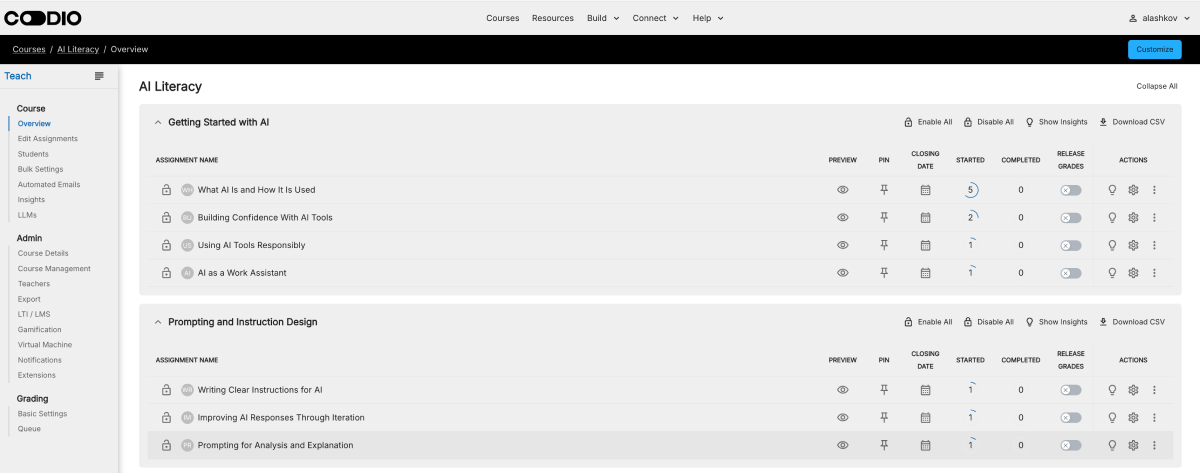
Instructors get auto-scoring, gradebook reporting, and visibility into how students work, not just what they submit.
Screenshot 2026-07-14 at 1.53.22 PM

Seamless LMS Sync

Everything flows through Canvas and your existing LMS. Grades pass back automatically.


unnamed (5) (1)

Simplified Delivery, Better Learner Outcomes

Codio removes the setup burden for instructors — no infrastructure to manage, no tools to configure. Students learn and get assessed inside one integrated platform, so faculty can focus on teaching, not tech support.

15%

Higher proficiency

50%

Reduction in support tickets

A First Look at AI Literacy in the Classroom

University of Tampa is the first institution to bring Codio's AI Literacy course into the classroom — required for all students starting this Fall.
Purple Background Update (1)
The University of Tampa logo transparent
Students don't just need to know how to use AI—they need to know how to evaluate it, apply it responsibly and understand when human judgment matters most. AI literacy is becoming a foundational workplace skill, and bringing it into the curriculum gives students the practical experience they'll need long after they graduate.
Jessica O'Brien
Coordinator for Spartan Studies Online Learning & Digital Literacy at the University of Tampa
The University of Tampa logo transparent
 Coming Soon
Work Ready Labs: Applied AI for Business Schools
Discipline-Specific Assignments
Real tasks built for the major — not generic AI exercises.
Early Access, First
Codio's early access partners see Work Ready Labs before anyone else.
Build Skills Your Students Will Actually Use at Work
Finance, Marketing, Operations
Applied AI tasks mapped to real business disciplines, not one-size-fits-all exercises.
From Classroom to Career
Students practice AI the way they'll use it on the job — not just in theory.

Bring practical AI skills into your classroom this Fall